



2022-3-8
Article and photo courtesy of Federation of the International Human Rights Museums- Asia Pacific
The Federation of the International Human Rights Museums- Asia Pacific (FIHRM-AP) was established in September 2019 at the ICOM General Conference held in Kyoto. Adhering to the mission of the Federation of International Human Rights Museums (FIRHM), FIHRM-AP encourages museums to expand their focus to cover human rights issues and form a supportive network for sharing, collaboration and learning. As a platform for museums and NGOs in the Asia-Pacific region, FIHRM-AP urges governments to carefully watch the development of human rights issues in this region. It works to build human-rights-oriented museum values to drive contemporary practices to further the cause.
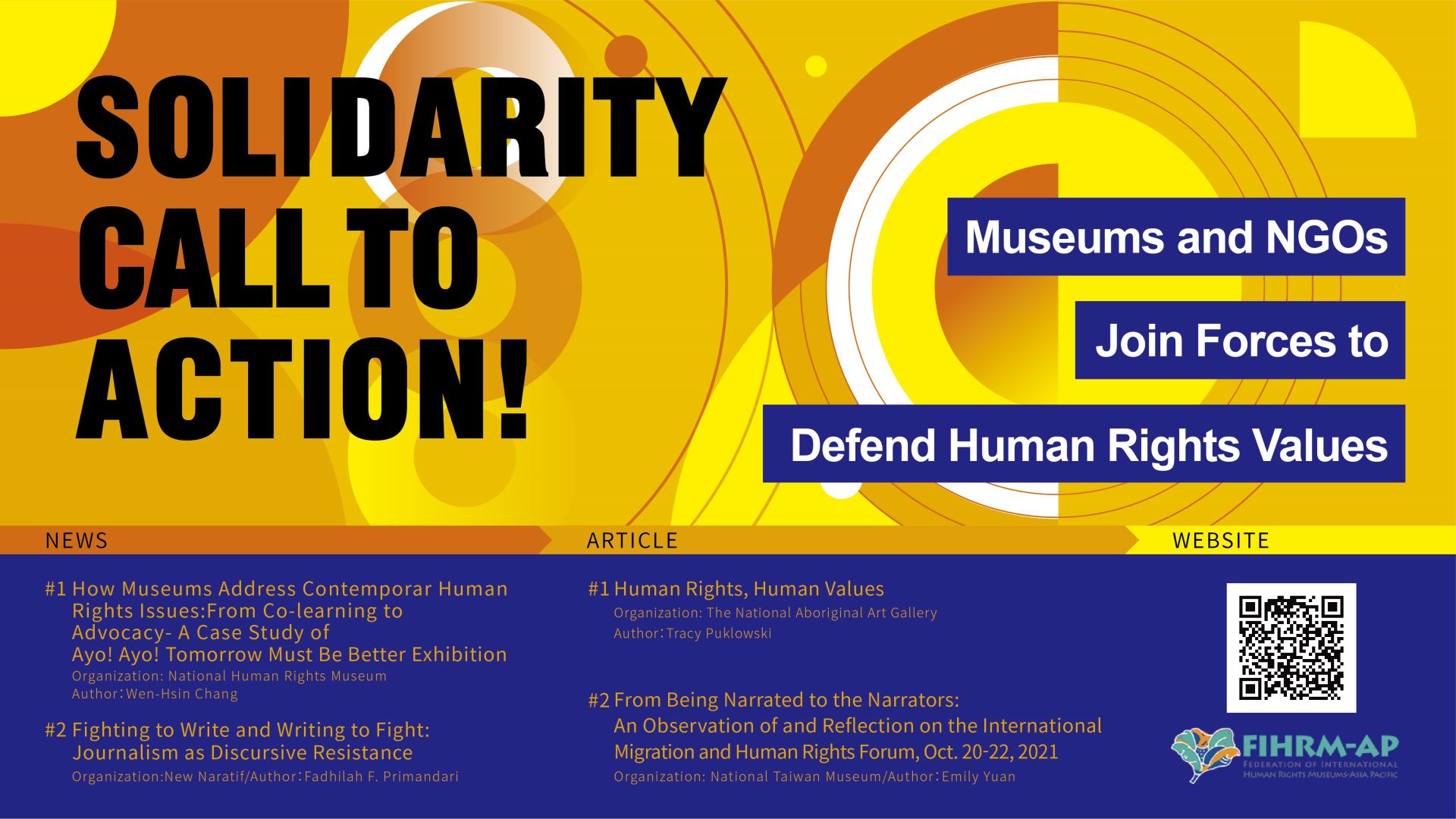
The FIHRM-AP official website also functions as an online media platform for information dissemination, which connects FIHRM-AP members to facilitate exchanges and partnerships. Like a sounding board, the network ensures that human rights values and philosophy can be amplified and solicit more positive responses in return. This year we plan to launch four issues of newsletters and feature articles. The first issue presents four articles on the theme of "A Solidarity Call to Action! Museums and NGOs Join Forces to Defend Human Rights."
By giving a recent update on museums and related organizations in the Asia-Pacific region and various issues, the newsletter introduces multiple human rights challenges and advocacy works in the region. In her article, “How Museums Address Contemporary Human Rights Issues: From Co-learning to Advocacy, A Case Study of Ayo! Ayo! Tomorrow Must Be Better Exhibition”, Chang, Wen Hsin from the National Human Rights Museum of Taiwan recounted how FIHRM-AP fostered a co-learning community for migrant rights by bringing together museums and NGOs. Members of this community shared practices of their respective institutions in response to the human rights issues and political quandary and formulated their cross-organizational curatorial action through group discussions.
"Fighting to Write and Writing to Fight: Journalism as Discursive Resistance" written by Fadhilah F. Primandari, the Democracy Researcher at New Naratif recounts how freelance journalists in Southeast Asia fight for freedom of reporting and expression in a challenging context. As a first-hand source of marginalized and local perspectives, what are the obstacles the independent journalists in Southeast Asia work around for their work and room for free speech? As readers, how can we join this fight? This article calls upon everyone to defend freedom of expression.
These feature articles offer insight into the challenges and contended issues specific to local contexts by revisiting, recounting and documenting human rights issues, activism and arguments in the Asia Pacific region. In her article, "Human Rights, Human Values," Tracy Puklowski, the director of the National Aboriginal Art Gallery, uses her experience as one of the inaugural council members to illustrate why museums should not look away from their responsibility to address sensitive and contested issues. She sincerely calls out in earnest to museums across the globe to address incidents and challenges involving human rights concerns that are all interconnected in a globalized world and also extend their focus to human rights violations happening at home.
In "From Being Narrated to the Narrators: An Observation of and Reflection on the International Migration and Human Rights Forum, Oct. 20-22, 2021," Emily Yuan of the National Taiwan Museum reviews the thought provoking topics covered in the International Migration and Human Rights Forum and Workshop held in Oct, 2021. The forum is a joint collaboration between FIHRM-AP and International Coalition of Sites of Conscience (ICSC). Practitioners of museums and human rights NGOs in countries like the United States, France, Australia, East Africa, Bangladesh, India and Taiwan spoke of human rights issues and phenomena that arose from transnational migration and shared their practices on the ground.
The above mentioned articles brilliantly join the dots with regard to human rights issues and activism in local contexts with the aim to inspire more diverse and creative practices and call on more organizations and individuals to join FIHRM-AP's fight for human rights values.
