



2026-8-31
(Courtesy of Taiwan Panorama Jane 2026)
Esther Tseng /photo by Jimmy Lin
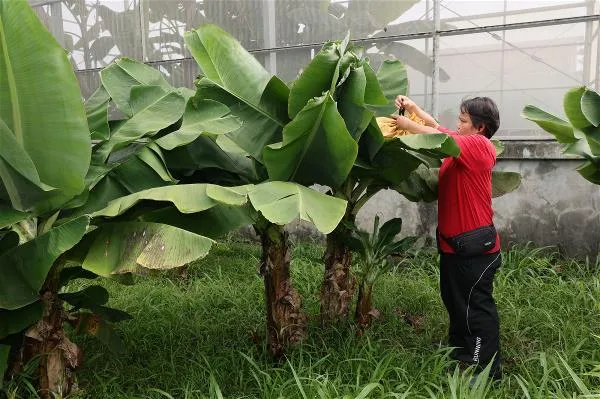
Fusarium wilt—often dubbed “banana cancer”—threatens the Central American banana sector, which is worth an estimated US$2.7 to 2.8 billion per year. In Taiwan, where farmland is intensively cultivated, the Taiwan Banana Research Institute (TBRI) has drawn on more than half a century of breeding expertise to help neighboring countries and diplomatic allies. With the disease-resistant Formosana banana and other climate-resilient cultivars, Taiwan has become an international focal point for banana know-how.
At the Taiwan Banana Research Institute (TBRI) in Jiuru Township, Pingtung County, a small banana plant heavy with fruit stands out. Only about 100 centimeters tall—shorter than most people—it is known as the “Three-Foot Banana.”
“This is a mutation of the Pei-Chiao banana,” says TBRI Director Lee Wen-li. “Its compact form gives it ornamental value and makes it practical for small spaces. We are working with a potted-plant grower whose ambition is to market the Three-Foot Banana in Europe as a houseplant. A cherry or apple tree at home is nothing unusual for Europeans, but a banana plant, especially one that bears fruit, is something special. It suggests you are wealthy enough to afford to keep the heat running all the time—enough to sustain a tropical plant like this.”
The secret to fighting “banana cancer”
To meet the challenges posed by extreme weather, subtropical Taiwan has bred banana cultivars resilient to environmental stress. One such cultivar has prompted inquiries from Japanese industry representatives, who are seeking approval from Taiwan’s agricultural authorities for its export to Japan. International attention, however, has focused most strongly on varieties resistant to Fusarium wilt.
Lee says Fusarium wilt Tropical Race 4 (TR4), often called “banana cancer,” is a widespread threat to the global banana industry. Because the soilborne pathogen can spread through soil, water, and infected planting material, many countries with abundant land rely on geographic isolation, designating hundreds of hectares as quarantine zones. In Eswatini, growers have opened new land for banana cultivation to limit the disease’s spread, with the Taiwan International Cooperation and Development Fund (TaiwanICDF) providing ongoing support for irrigation facilities and technical production guidance.
In intensively farmed Taiwan, the Fusarium wilt TR4 pathogen can spread quickly. That pressure led TBRI to begin selection and breeding work against it in 1970, establishing the host spectrum of the disease, screening for highly resistant cultivars, and producing healthy plantlets. Decades of accumulated expertise have earned Taiwan an international reputation in Fusarium wilt prevention.
Banana Breeding Basics
Edible bananas are triploid and do not produce viable seeds for propagation. Commercial growers therefore multiply them either from suckers or through tissue culture using the plant’s growing point—a form of vegetative propagation—to multiply elite cultivars in large numbers. Tissue culturing is the most critical step in maintaining pathogen-free plant quality.
Taiwan Can Help: Plantlets, expertise, and certification
In Central America, banana production is worth an estimated US$2.7 to 2.8 billion a year and forms part of the region’s economic lifeblood. In recent years, TR4 has spread from South America toward Central America, putting production areas under mounting stress and prompting countries to seek Taiwan’s technical assistance.
Through TaiwanICDF, Taiwan began providing disease-resistant planting material—including Formosana—to diplomatic allies including Guatemala and Belize in 2022. It has also stationed technical experts, helped build marketing channels, and established demonstration farms in these lands.
Lee explains that smallholders in the region traditionally dug suckers at random from fields for propagation, a practice that can carry pathogens and produce uneven stands. The healthy tissue-cultured plantlets promoted by Taiwan (specific pathogen-free plantlets) have genetic traits that confer resistance to Fusarium wilt and are also free of Deightoniella leaf spot, banana mosaic disease, and banana bunchy top disease, helping to increase yields.
TaiwanICDF also sought to incorporate a “healthy plantlet certification system” into its “Regional Project for the Prevention and Control of Fusarium TR4 of Banana in Central America.” The aim went beyond introducing Taiwan’s resistant cultivars: It also sought to help Central America develop healthy-plantlet testing and certification capacity, while integrating smart-agriculture tools such as Taiwan’s remote sensing technology. Even a 10% increase in production value would generate remarkable gains in earnings. This was “Taiwan Can Help” in practice—and an example of Taiwan extending its international influence through durable systems and technical expertise.
What sets Taiwan’s bananas apart
In the busy nursery and sterile tissue-culture center, Thai researcher Supaporn Pimsaman deftly handles production and management. The facilities can raise up to 2.5 million healthy tissue-cultured plantlets and vigorous young plants each year, supplying fruit-marketing cooperatives, satellite nurseries, and local growers. This steady flow of clean planting material underpins the healthy development of Taiwan’s banana industry.
When it comes to flavor, Lee says proudly that Taiwan’s bananas owe their taste to a distinctive combination of geography and climate. That sets them apart from bananas grown quickly under year-round heat in some countries’ large, uniform plantations.
Specifically, winter and spring in Taiwan bring mild cooling and wide day–night temperature swings. Warm daytime conditions boost photosynthesis and sugar accumulation; cooler nights reduce the plant’s use of stored nutrients, allowing fruit to mature slowly on the plant. Combined with Taiwanese growers’ advanced orchard management technology and techniques, these conditions produce a uniquely dense, creamy texture and rich aroma. Lee says this is why Taiwan-grown bananas remain popular in Japan even though they can cost nearly three times as much as Philippine bananas in Japanese supermarkets.
Whether the product is richly flavored fruit or planting material bred to withstand disease and warming temperatures, Taiwan has every reason to take pride in its bananas.
Taiwan’s All-Star Banana Lineup
.Tai-Chiao No. 4 (Formosana) combines proven disease resistance with robust agronomic performance, making it one of Taiwan’s principal cultivars for overseas licensing and promotion.
.Tai-Chiao No. 7 has advanced to field trials in Malaysia.
.The “Oolong” banana, selected from Tai-Chiao No. 1, has the largest planting area in Taiwan and is highly favored by local growers.
